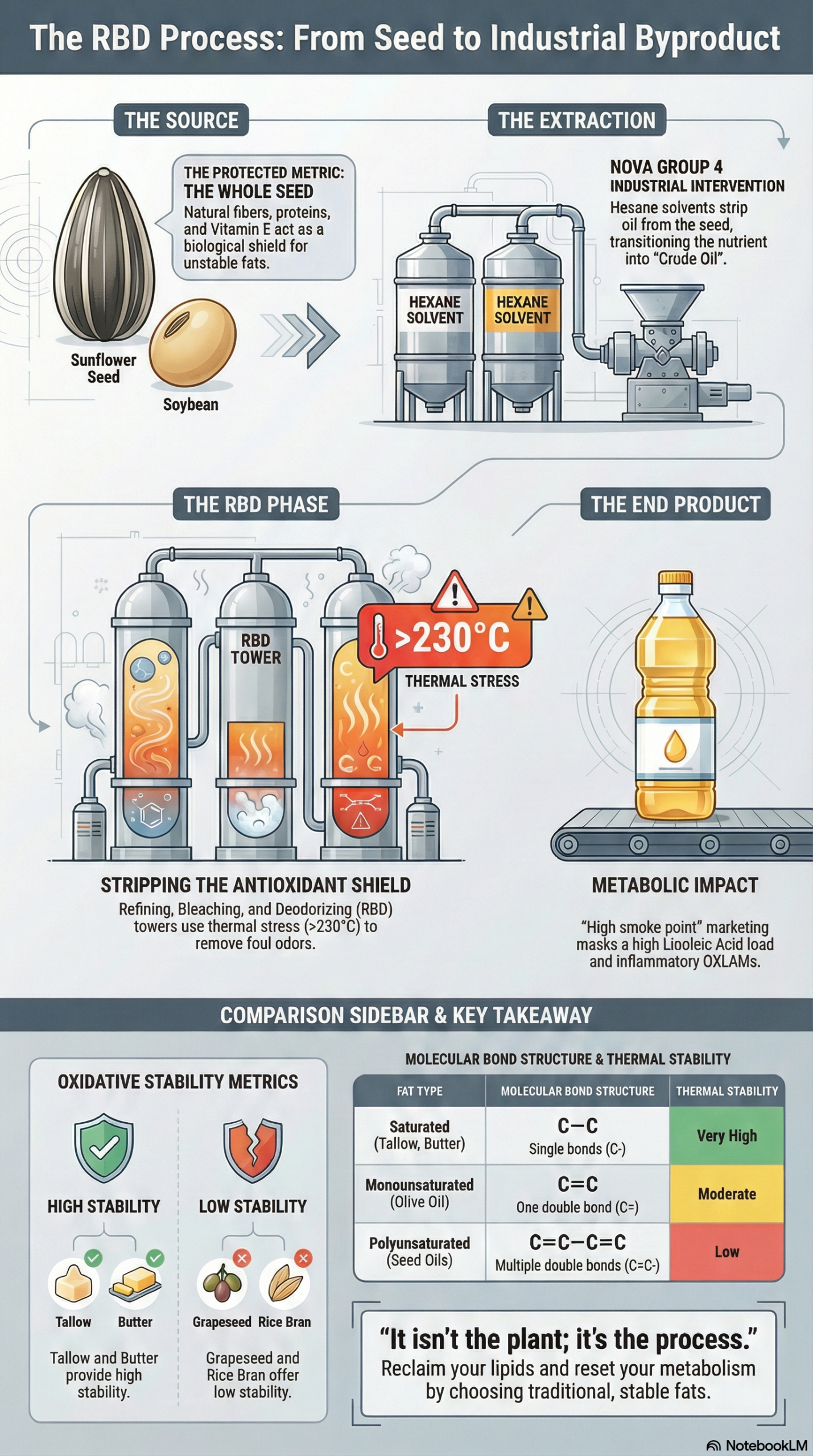
I. The Protection Metric: The Loss of the Shield
- The Whole Seed: In a soybean or sunflower seed, the polyunsaturated fatty acids (PUFAs) are encased in a “Food Matrix” of fiber, protein, and high concentrations of Vitamin E. This matrix acts as a biological shield, preventing the unstable double bonds from oxidizing during storage or digestion.
- The RBD Oil: The Refined, Bleached, Deodorized (RBD) process strips this shield. Through hexane extraction and high-heat steam distillation ($>230^{\circ}$C), the natural antioxidants are removed, leaving the “naked” PUFAs vulnerable to immediate thermal oxidation.
II. The Stability Metric: The “Smoke Point” Deception
Grapeseed and Rice Bran oils are often marketed for their high smoke points. However, the 2026 Reset identifies this as a misleading metric.
- Oxidative Stability is the true measure of safety. Because Grapeseed oil is $>70\%$ linoleic acid, it begins to decompose and create toxic metabolites (OXLAMs and 4-HNE) long before it ever produces visible smoke.
- Thermal Stress: An oil can be “clear and odorless” but already “pre-oxidized” due to the deodorization phase of RBD processing. When this oil is used for cooking, it accelerates a chain reaction of cellular inflammation.
III. The Concentration Metric: Evolutionary Volume
To obtain the amount of linoleic acid found in a single tablespoon of soybean oil, one would have to consume an evolutionary impossible volume of whole soybeans. The RBD process allows for a “Lipid Flood” that bypasses the body’s natural satiety signals (fiber and protein).